
Granite State Tang Soo Do
Milton, New Hampshire
당수도 A legacy of tradition, a future of transformation
We don't just teach technique. We carry something forward.
Tang Soo Do — 당수도, "the way of the knife hand" — is a classical Korean martial art whose roots run back through monks, scholars, palace guards and warrior societies. When a student bows into our dojang in Milton, they're stepping into a line of teaching that survived dynasties, occupation and near-extinction to reach them.
Martial arts here is more than movement. It's the passing of timeless wisdom from one generation to the next, master to student, parent to child. This is where ours comes from.
“In order to master the Way of Strategy, you must study the other martial arts, and you must not abandon the Way of the warrior at all. You must set your mind upon practicing every single day, hour by hour.”
Miyamoto Musashi · Undefeated Samurai · 1584–1645
당수도 Why the history matters
Tradition is a training method, not decoration
The ancestral arts emerge
The unarmed fighting systems that would eventually shape Tang Soo Do begin appearing across the Korean peninsula and mainland Asia.
The Three Kingdoms
Silla, Koguryo and Paekche are founded. Each develops its own warrior traditions, and martial training becomes part of a nobleman's education.
The five codes are written
The monk Won Kwang drafts the five codes of conduct for the Hwa Rang warriors — loyalty, respect, courage, justice and discretion. Students still recite their descendants today.
Unification under Silla
The Hwa Rang Dan — an elite corps of young aristocrat-warriors — proves instrumental in uniting the peninsula, and furnishes many of the era's leaders.
Koryo and Yi dynasties
Korean martial practice survives dynastic upheaval, passed hand to hand through generations of soldiers and teachers.
The Moo Yei Do Bo Tong Ji
The single most important surviving document of Korean martial arts is compiled and illustrated — the written proof of a native fighting tradition.
Occupation and suppression
During the Japanese occupation, practicing and teaching Korean martial arts is restricted. The art goes underground and nearly disappears.
Moo Duk Kwan is founded
Weeks after liberation, Master Hwang Kee founds the Moo Duk Kwan — the 'Institute of Martial Virtue' — originally calling his art Hwa Soo Do, the way of the flower hand.
The name Tang Soo Do
After meeting Won Kuk Lee — who had coined 'Tang Soo Do' at his Chung Do Kwan in Seoul — Hwang Kee integrates the name and the art into his own discipline. Modern Tang Soo Do is born.
Rediscovering Soo Bahk
Hwang Kee discovers the Moo Yei Do Bo Tong Ji, recognizes Soo Bahk as the traditional Korean root of the art, and incorporates the Korean Soo Bahk Do Association.
The great divergence
The Korean Tae Soo Do Association forms and later becomes the Korean Tae Kwon Do Association. The Moo Duk Kwan declines to unify — preserving Tang Soo Do as its own traditional art.
Atlantic-Pacific Tang Soo Do Federation
Founded in Atlanta, Georgia by Founding Master John St. James to keep classical Tang Soo Do standards alive across North America — the federation family our school belongs to.
Shawn Burns steps onto the mat
A Milton man takes his first Tang Soo Do class. He falls for the training, and even faster for what it does for the people training beside him.
Certified to teach
Shawn earns his instructor training certification, adds First Aid and CPR certification, and starts thinking about what a school of his own could do for his hometown.
Granite State Tang Soo Do opens
Shawn opens the doors in Milton, New Hampshire — not to run a business, but to make a difference in his community and in the lives of others. Marianne and Abigail join him on the floor.
Your story starts here
Three generations of Milton families now train under the same crest. The next line of this history is written by whoever walks in and bows for the first time.
당수도 Why the history matters
Tradition is a training method, not decoration
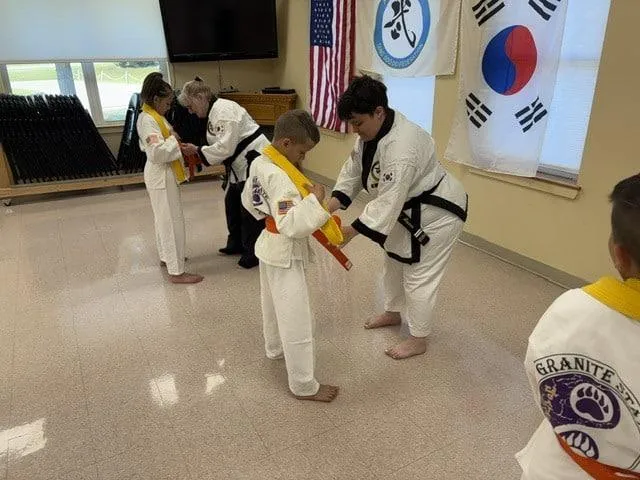
The bow at the door, the Korean terminology, the forms passed down unchanged for decades — none of it is theater. It's how the art keeps its standards honest across generations. A green belt in Milton performs the same form a green belt performed fifty years ago, and can walk into a federation event anywhere and be understood.
It's also how we teach character. Respect isn't a poster on our wall; it's built into the way you enter the floor, address your seniors and treat the white belt beside you. The five tenets our students recite are direct descendants of the codes written for the Hwa Rang warriors roughly eighteen centuries ago.
That's what your family joins when you sign up. Not a gym membership, a lineage.
당수도 Ready when you are
Your first two classes are on us
Walk in as a visitor. Walk out as part of the family. No contracts to sign, no gear to buy, no pressure! Just two real classes so you can see what training here feels like.
A family-owned, family-friendly traditional Tang Soo Do school serving Milton, Rochester, Farmington and the surrounding Granite State communities since 2016.


Programs
Monday - Closed
Tuesday - Closed
Wednesday - Closed
Thursday - 6:30 – 8:00 PM
Friday - Closed
Saturday - 8:00 – 10:00 AM
Sunday - Closed
© 2026 Granite State Tang Soo Do. All rights reserved.
Website by: Catchings Creative